
 Empire State Review Contributor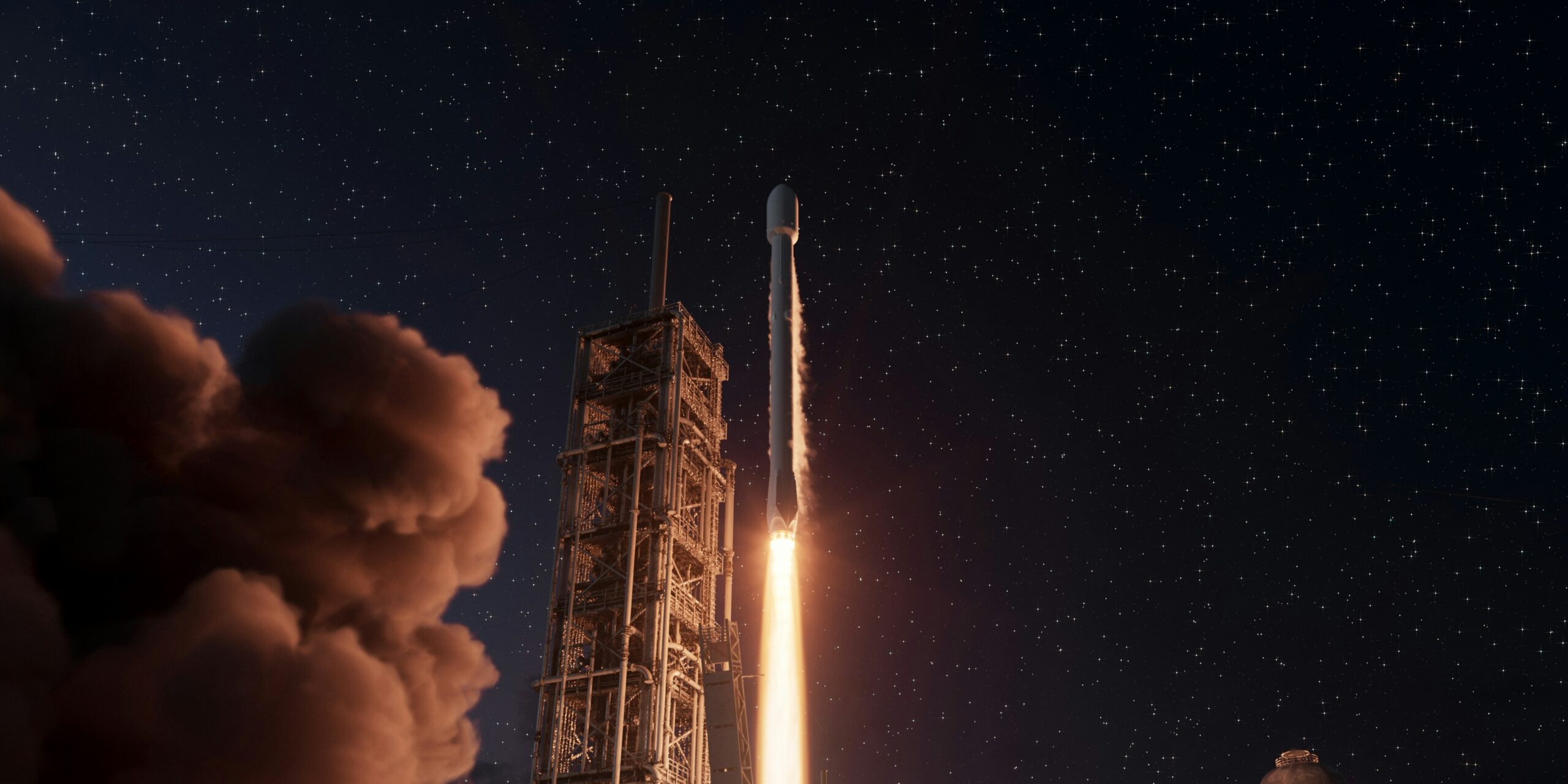
On November 13, 2025, Blue Origin’s New Glenn rocket took center stage in a dramatic display of both technological prowess and environmental awareness. As the aerospace company prepared for its third attempt to launch the heavy-lift rocket from Cape Canaveral, the skies above much of the northern United States shimmered with vibrant auroras triggered by a severe geomagnetic storm. The convergence of these two space-related events—one human-made, the other natural—offered a compelling reminder of how modern spaceflight must increasingly navigate not only engineering challenges but also the dynamic conditions of space weather.
New Glenn, named after pioneering astronaut John Glenn, was originally scheduled for launch earlier in the week. However, heightened solar activity forced a delay, prompting Blue Origin to push the launch window to the afternoon of November 13, between 2:57 and 4:25 p.m. Eastern Time. The postponement followed a powerful coronal mass ejection (CME) from the Sun that sent charged particles hurtling toward Earth, creating both operational concerns and visual splendor. As a result, skywatchers across states like Michigan, Minnesota, and Wisconsin were treated to rare sightings of the northern lights far south of their usual range.
The impact of space weather on launch operations is becoming increasingly significant. In this case, the decision to delay the launch was driven by concerns over radiation exposure and the potential for electrical interference with both the rocket and its payload. Aerospace engineers and mission planners have grown more attuned to these risks in recent years, as reliance on satellite-based infrastructure and deep-space missions grows. The New Glenn delay was not an outlier but part of a growing trend where natural space phenomena are key variables in mission scheduling.
When liftoff finally occurred, it marked a critical milestone for Blue Origin. The mission carried two NASA ESCAPADE (Escape and Plasma Acceleration and Dynamics Explorers) satellites, designed to study the magnetosphere of Mars, as well as a technology demonstration payload from ViaSat. The launch was part of Blue Origin’s broader effort to establish New Glenn as a reusable heavy-lift platform capable of competing with SpaceX’s Falcon Heavy and Starship programs. Achieving orbit and deploying interplanetary payloads represents a substantial step forward in that effort.
Adding to the significance of the launch, Blue Origin successfully recovered the rocket’s first-stage booster on its ocean-based landing platform, “Jacklyn,” stationed in the Atlantic. This marked the first time the company completed both an orbital mission and a first-stage landing in the same flight—a critical proof point for its reusable launch system ambitions. The recovery of the booster not only saves costs for future missions but also places Blue Origin in closer alignment with the increasingly standard industry expectation of launch vehicle reusability.
The mission’s success reflects years of development and adaptation. New Glenn’s earlier test flights had demonstrated orbital capability but failed to achieve booster recovery. By overcoming those setbacks and managing the timing of this launch around a solar event, Blue Origin showcased not only technical skill but also strategic foresight. Company officials hailed the achievement as a turning point in their journey to support future deep-space exploration, lunar logistics, and large-scale satellite deployment.
The broader implications of this launch extend beyond Blue Origin’s corporate ambitions. It highlights the growing interdependence between human space activity and the space environment. With solar cycles becoming more active and geomagnetic storms more frequent, space agencies and private companies alike are developing protocols to monitor and respond to space weather. This includes real-time solar observation, modeling of radiation exposure risks, and dynamic mission planning to ensure both astronaut and spacecraft safety.
For NASA, the deployment of the ESCAPADE satellites is an important component of its upcoming Mars science initiatives. The twin spacecraft will study how solar winds and the Martian magnetosphere interact, which could yield insights into atmospheric loss on the Red Planet and inform future crewed missions. This data is essential for understanding how to protect both human and robotic explorers in hostile space environments.
The timing of the launch, juxtaposed with vivid auroral displays, offered a visual metaphor for the era we are entering—one where Earth and space are more intertwined than ever. While humans reach farther beyond our atmosphere, we remain subject to the rhythms and forces of the cosmos. Blue Origin’s New Glenn launch, delayed by the Sun and crowned by success, stands as a symbol of the adaptive, interconnected future of aerospace exploration.
As commercial spaceflight continues to mature, the industry will be challenged to operate not just against the clock or competitive benchmarks but within a larger framework of environmental awareness and resilience. The story of this launch is not just about engineering success—it is about how the next frontier will be shaped as much by solar storms as by silicon and steel.