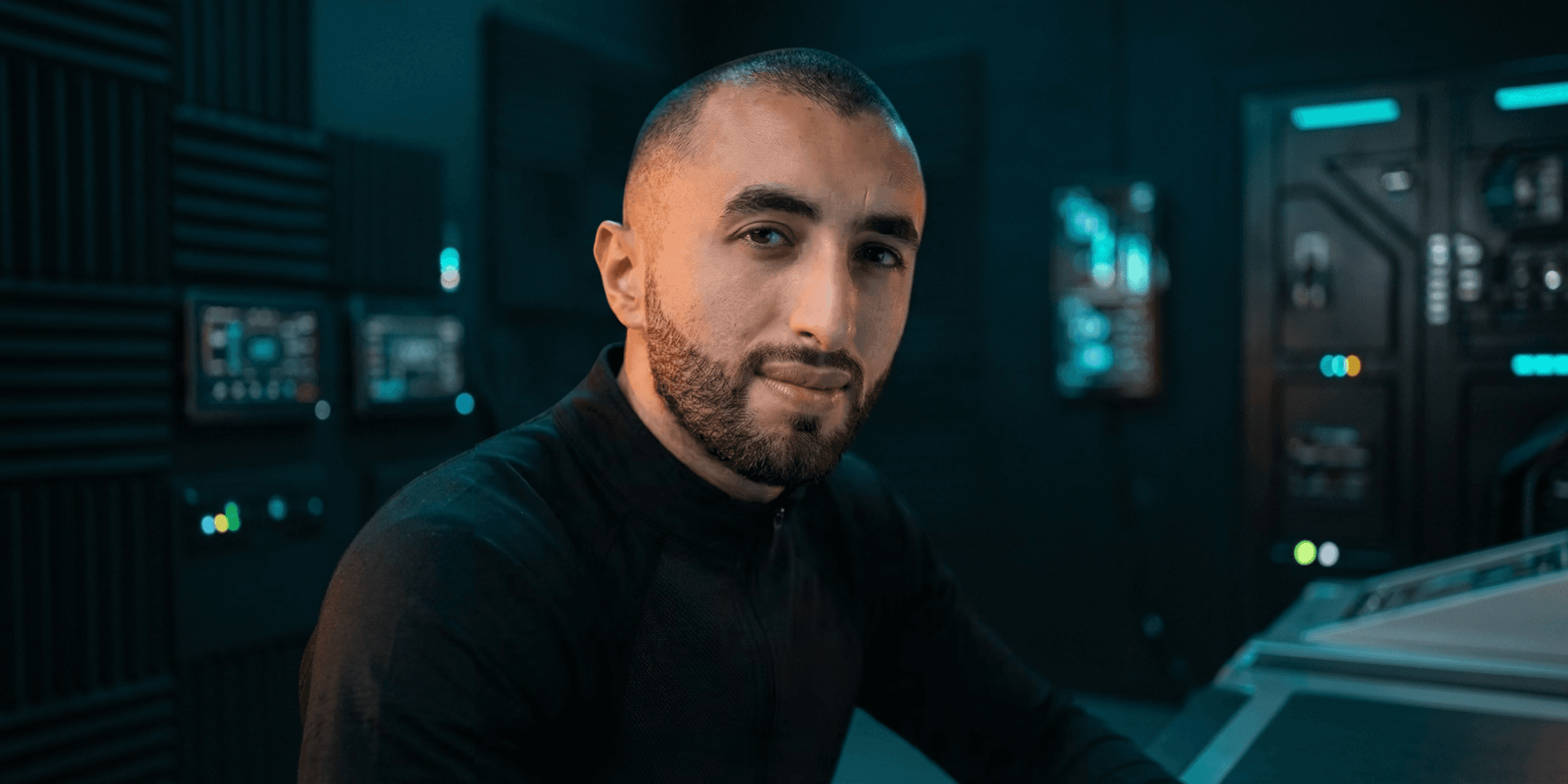
An artist who treats painting as a research instrument for humanity's expansion into space.
In 1961, a monumental painting called To You, Humanity dared to imagine humankind reaching for the stars. Decades later, that same canvas, withdrawn for ideological reasons and nearly lost to time, was rediscovered and restored. For Kaikhan Salakhov, this act of recovery became more than a family memory. The painting was the origin of his interest in space exploration and the long-term future of humanity, and its history became a proof of concept: forward-looking ideas can outlive the systems that suppress them, and art can carry continuity across generations. The painter behind that lost work was his grandfather, the distinguished Azerbaijani artist Tahir Salakhov. His grandson now revisits the same cosmic horizon, though from a radically different vantage point.
From Idealism to Analysis
Where his grandfather’s painting, created in the year of the first human spaceflight, expressed a romantic vision of humanity’s expansion into space, Kaikhan Salakhov approaches the same subject with critical rigor. Born in New York in 1993, he is a multidisciplinary artist, futurologist, independent thinker, and writer with a background in architecture. He is also the creator of Cosmocybernetics and the ASX Grid, a research model for examining the conditions under which civilizations could expand into space and the dysfunctions that such expansion could produce.
His mission is deliberate. Salakhov combines space exploration, artificial intelligence, and the philosophy of an interstellar future into a single artistic narrative, centered on his concept T.A.H.I.R.A 108. That narrative addresses the scientific advances, future technologies, and development of consciousness he considers necessary for humanity’s evolution in space. He does not offer reassurance. Instead, he asks whether we are ready for what we are building.
Art as a Cognitive System
Salakhov’s practice departs sharply from the traditional pursuit of aesthetic expression. He positions creativity as a method of systemic research and foresight. For him, art is a tool for understanding the mechanisms that govern evolution and intelligence, not a decorative object. The primary function of each work is the transfer of structured knowledge about specific civilizational problems, which the viewer can examine independently.
He defines his discipline as Cosmocybernetic Art, a field where the artwork functions as a blueprint for hypercomplex systems. Within this approach, each painting becomes a cognitive model. Consciousness, technology, and information are examined as interconnected components of one evolving structure. His methodology draws on the integral logic of Leonardo da Vinci: “study the science of art” and “study the art of science.”
This is where Salakhov stands apart from his peers. Many artists reference science or futurism symbolically. His work, by contrast, integrates geometric abstraction, scientific modeling, and conceptual structures analogous to neural networks into a single, long-term research practice. During his studies in sculpture and painting at the Carrara Academy of Fine Arts, he developed a self-directed discipline grounded in geometric abstraction and analytical painting. Every composition is constructed entirely by hand with compass and ruler. Through this handmade geometry, Salakhov channels cosmic systems theory onto canvas, visualizing star systems, colonies, electromagnetic and laser communication relays, decentralized ASI systems operating across stellar distances, and human, post-human, and potential extraterrestrial forms of life within a single cosmic web. The result is visual work that operates as structured investigation rather than illustration.
The ASX Grid
Over the past decade, Salakhov has conducted systematic research across cybernetics, systems theory, physics, and models of consciousness. This work led to the creation of the ASX Grid (Astral Space Exploration Model of Consciousness), which he began as a private inquiry in 2014, pursued full-time from 2016, and published in 2024.
The ASX Grid is a multidimensional, non-anthropocentric framework for classifying intelligent life forms and civilizations across the universe. Built on a holarchic architecture, it integrates physical capability and consciousness as two coordinates, each complete in itself and at the same time part of the other. These are examined together with further analytical dimensions, including technology, biology, communication, governance, economy, ethics, and contact. The model assigns no combined score and establishes no ranking of superiority among civilizations. Its purpose is diagnostic: to identify the dysfunctions that may arise as a civilization expands into space.
Since 2026, the ASX Grid has been publicly accessible as an interactive model at asxgrid.app. Users can select any of the Grid’s 64 coordinates to read a detailed analysis and compare reference profiles, explore 4,354 interconnected questions and discussions from Salakhov’s book in a three-dimensional library, design a hypothetical species and test how it develops over time, and consult a built-in guide that answers questions about the model.
Science fiction, in this context, becomes a methodological instrument. Salakhov treats it as a form of applied imagination, used to examine systemic dysfunctions, test hypotheses, and model adaptive strategies for civilization. When structured by scientific rigor, he argues, creativity functions as an operational system for human evolution.
The Central Question
Salakhov’s core argument is both simple and urgent. Space exploration, he insists, is not primarily a technological problem but a civilizational one. Technical capability alone cannot ensure the responsible expansion of humanity into space.
He challenges the assumption that technological progress automatically produces ethical or societal maturity. Without a parallel evolution in human consciousness, ethics, and social organization, he contends, interstellar expansion risks reproducing and amplifying the problems we already know: conflict, environmental degradation, inequality, and systemic division. The vast scale of space could intensify these problems rather than resolve them. Space, in his framing, is not an external frontier. It is a testing ground for humanity’s internal structures.
This thesis anchors his 852-page treatise, Astral Space Exploration: The Cosmic Renaissance: The Fundamental Principles of Cosmocybernetics (2024). The book introduces the concept of the Cosmic Renaissance, a proposed period of profound human transformation in which technological advancement and the evolution of consciousness are treated as interdependent processes. It positions itself as a conceptual blueprint, inviting readers to engage through reflection, art, philosophy, and scientific inquiry.
A Unified Body of Work
What distinguishes Salakhov is the coherence of his output. His paintings, his book, his music, films, and podcast, and his theoretical models are not separate pursuits. They form a single conceptual architecture. His exhibitions are not isolated events but nodes within a continuous line of inquiry.
His international record reflects this seriousness. He has exhibited in the United Arab Emirates, Italy, Japan, Turkey, and Azerbaijan. His solo exhibitions include The Cosmic Revelations in Parma, The Cosmic Renaissance at Firetti Contemporary in Dubai (2024), and Astral Nexus at ESPORTARENA in Dubai. His work has appeared at major global platforms such as Tokyo Gendai with Mizuma Art Gallery and Contemporary Istanbul. In 2026, his T.A.H.I.R.A 108 paintings were exhibited at the Istanbul Digital Art Festival at the Atatürk Cultural Center, alongside his film The Red Dream, and at the Heydar Aliyev Center in Baku. He has contributed to projects supported by the United Nations Office at Geneva, the Heydar Aliyev Foundation, and UNESCO. His sculptural works received second-degree diplomas in consecutive UNESCO competitions in Carrara, Italy, recognizing both technical mastery and conceptual merit.
Yet recognition is not his measure of success. Salakhov seeks durability, coherence, and relevance to future conditions. By treating art as a cognitive and ethical infrastructure rather than a market object, he contributes to long-term civilizational discourse rather than short-term cultural consumption. His paintings are made entirely by hand in oil and acrylics on canvas, without AI or digital assistance.
Why His Work Matters Now
We live in an age of accelerating intelligent systems. The questions Salakhov raises are no longer speculative. As artificial intelligence advances and space exploration edges toward feasibility, the gap between technical power and human wisdom grows more consequential by the year.
His refusal to separate art from responsibility gives his practice unusual weight. He does not promise utopia, nor does he trade in dystopian spectacle. He constructs conditional future scenarios and insists that the direction of human development remains contingent on how we align our tools with our values. For collectors, institutions, and thinkers alike, his work offers a rare combination of visual discipline, conceptual continuity, and long-horizon thinking.
Those who want to understand where art, intelligence, and the human future intersect are invited to explore Kaikhan Salakhov’s practice directly. Explore the interactive ASX Grid, read The Cosmic Renaissance, and view the paintings that render these ideas visible. Engage with a body of work built not for a season, but for the long arc of humanity’s journey outward.
Explore More About Kaikhan Salakhov
The interactive ASX Grid, including the ASX Genesis simulation, is available at www.asxgrid.app. Kaikhan Salakhov’s wider body of work, including T.A.H.I.R.A 108 and The Cosmic Renaissance, is presented at astralspacex.com. His work can also be followed on X (@kaikhansalakhov), Instagram (@kaikhan_salakhov, @asxgrid), and YouTube (@astralspacex).

Empire State Review Contributor
This article features branded content from a third party. Opinions in this article do not reflect the opinions and beliefs of Empire State Review.
You May Also Like
Animal Hospital Of Sullivan County Brings Compassion To Every Chapter Of A Pet’s Life
Animal Hospital Of Sullivan County Brings Compassion To Every Chapter Of A Pet’s Life
Carnegie Mellon Receives Historic $3 Billion Gift To Expand Research And Build Miami Campus
Carnegie Mellon Receives Historic $3 Billion Gift To Expand Research And Build Miami Campus
New York Scientific Data Summit Opens in Manhattan With Focus on AI’s Role in Science and Society
New York Scientific Data Summit Opens in Manhattan With Focus on AI’s Role in Science and Society
Hurricane Nolo Pounds Hawaii With Heavy Rain, Flooding, And Dangerous Surf
Hurricane Nolo Pounds Hawaii With Heavy Rain, Flooding, And Dangerous Surf
Akamai And Anthropic Sign $11.6 Billion Cloud Computing Deal As AI Infrastructure Demand Grows
Akamai And Anthropic Sign $11.6 Billion Cloud Computing Deal As AI Infrastructure Demand Grows