
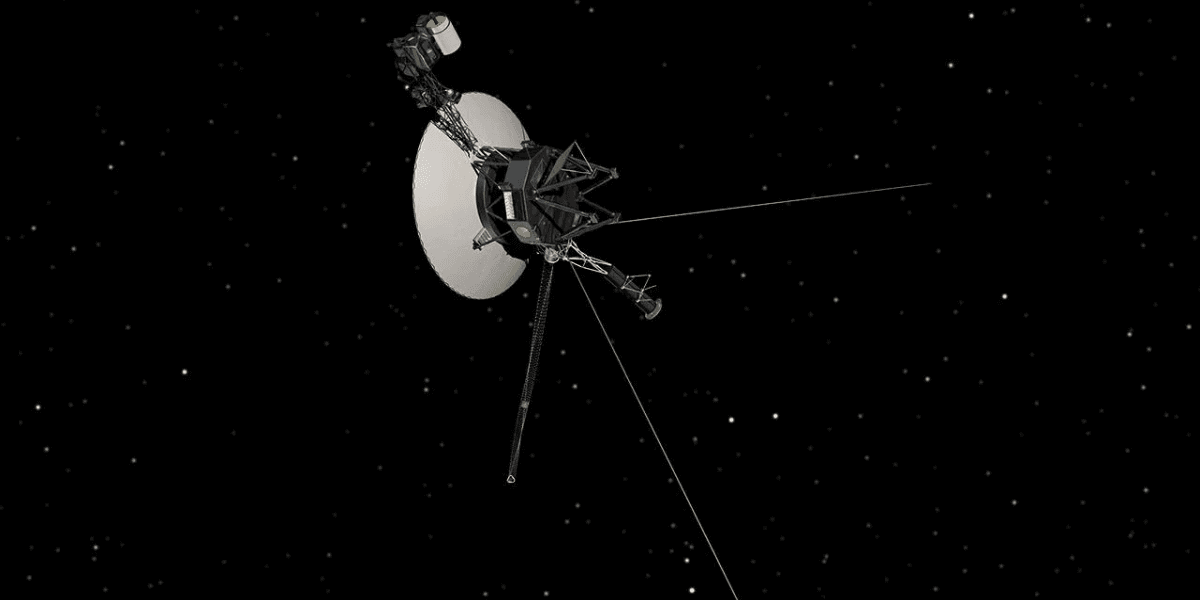
NASA prepares to celebrate Voyager 1 as the spacecraft approaches a historic distance of one light day from Earth.
A Historic Moment for Space Exploration
Nearly five decades after leaving Earth, NASA's Voyager 1 spacecraft is approaching a milestone that highlights the extraordinary reach of human space exploration. The spacecraft is expected to become the first human made object to travel one light day away from Earth, marking another remarkable achievement in the history of scientific discovery.
On November 10, 2026, the National Aeronautics and Space Administration announced plans for a worldwide celebration of the upcoming milestone. Voyager 1 is expected to reach the distance on November 18, when it will be approximately 16.1 billion miles, or 25.9 billion kilometers, from Earth.
The announcement represents an important moment for NASA and the scientific community. It also offers the public an opportunity to learn more about a mission that has continued far beyond its original expectations.
A light day refers to the distance light travels in 24 hours. Because light moves at approximately 186,000 miles per second, the distance is enormous. Once Voyager 1 reaches this milestone, a radio signal traveling from Earth to the spacecraft will require approximately 24 hours to arrive.
Voyager 1's Extraordinary Journey Since 1977
Voyager 1 began its journey on September 5, 1977, when NASA launched the spacecraft from Cape Canaveral, Florida. Its original mission focused on studying the outer planets of the solar system, particularly Jupiter and Saturn.
The spacecraft delivered valuable observations of both planets, including their atmospheric conditions, magnetic environments, rings, and moons. These discoveries helped scientists develop a better understanding of planetary systems.
One of its most important achievements came in 2012, when Voyager 1 became the first human made spacecraft to enter interstellar space. This region lies beyond the heliosphere, the protective bubble created by the Sun's magnetic field and charged particles.
Voyager 2, its twin spacecraft, followed a separate trajectory and entered interstellar space in 2018.
Together, the two missions provided humanity with its first direct measurements of conditions beyond the Sun's protective environment. Their findings continue to help researchers investigate the structure and behavior of the space between stars.
Why the One Light Day Milestone Matters
Voyager 1 reaching one light day from Earth represents more than a distance record. It demonstrates how far human engineering and scientific ambition can extend beyond our planet.
The milestone also provides a practical illustration of the challenges involved in communicating with spacecraft operating at extreme distances.
Radio signals travel at the speed of light. However, even this extraordinary speed cannot eliminate the delays associated with deep space exploration.
At a distance of one light day, a command sent from Earth would take approximately 24 hours to reach Voyager 1. A response would require another 24 hours to return.
This means mission controllers must carefully plan spacecraft operations rather than depend on immediate communication.
The delay also highlights the importance of autonomous systems, reliable engineering, and careful mission management.
For researchers, Voyager 1 remains particularly valuable because it continues to provide information about an environment that cannot be studied directly through ordinary observations from Earth.
NASA Invites the Public to Celebrate the Achievement
To recognize the upcoming milestone, NASA announced an international public participation initiative called Shine Bright for Voyager's Light Day.
Scheduled for November 17, the evening before the expected milestone, the activity invites people around the world to shine lights toward the sky after sunset.
Participants can use flashlights, mobile phone lights, glow sticks, and other small light sources. NASA also provides an online tool that flashes the letters VGR in Morse code, representing Voyager's mission call sign.
The initiative is symbolic. A flashlight or mobile phone cannot physically communicate with Voyager 1 across such an enormous distance. Instead, the activity gives people a shared way to recognize the spacecraft's achievement and celebrate the engineers and scientists behind the mission.
NASA also plans a moderated discussion on November 19, giving audiences another opportunity to learn about the spacecraft and its scientific contributions.
The initiative demonstrates how major scientific achievements can connect researchers, educators, students, and the wider public.
Keeping a Nearly 50 Year Old Spacecraft Operating
One of the most remarkable aspects of Voyager 1 is its continued operation despite its age.
The spacecraft was designed using technology from the 1970s. Its systems have endured decades of exposure to the harsh conditions of space while traveling farther from Earth than any other human made object.
However, maintaining the mission has become increasingly challenging.
Voyager 1 depends on a radioisotope power source that generates electricity from the natural decay of plutonium. Its available power decreases gradually over time.
NASA engineers have responded by switching off selected systems and managing electricity carefully to preserve essential spacecraft functions.
These adjustments require extensive planning because the spacecraft cannot be physically repaired or serviced at its current distance.
The mission's continued operation reflects the importance of long term engineering and the ability of scientific teams to adapt to unexpected challenges.
What Voyager 1 Means for Future Space Exploration
Voyager 1's approaching milestone offers important lessons for the future of space exploration.
First, major scientific achievements often require patience. The spacecraft has traveled for almost 50 years to reach a distance that light itself crosses in a single day.
Second, long duration missions depend on careful engineering. Maintaining equipment for decades requires innovative solutions, continuous monitoring, and effective use of limited resources.
Finally, Voyager 1 demonstrates the lasting value of scientific exploration. Its discoveries have expanded our understanding of the solar system and provided researchers with an opportunity to investigate interstellar space.
As November 18 approaches, the spacecraft's journey offers a powerful reminder of humanity's ability to explore beyond familiar boundaries. Its record will stand as another important chapter in the history of space science, while the information it continues to provide may help future generations understand the vast environment beyond our solar system.

Empire State Review Contributor
This article features branded content from a third party. Opinions in this article do not reflect the opinions and beliefs of Empire State Review.
You May Also Like

EKOE: Best Business Technology in the United States of 2026
EKOE: Best Business Technology in the United States of 2026
Waymo Suspends Driverless Freeway Rides Across the U.S.
Waymo Suspends Driverless Freeway Rides Across the U.S.

RAYE Leads 2027 Grammy Nominations With 11
RAYE Leads 2027 Grammy Nominations With 11
Nationwide FAA Shutdown Disrupts Thousands of U.S. Flights
Nationwide FAA Shutdown Disrupts Thousands of U.S. Flights

Brooklyn Building Collapse Leaves Eight Dead in Flatbush
Brooklyn Building Collapse Leaves Eight Dead in Flatbush