
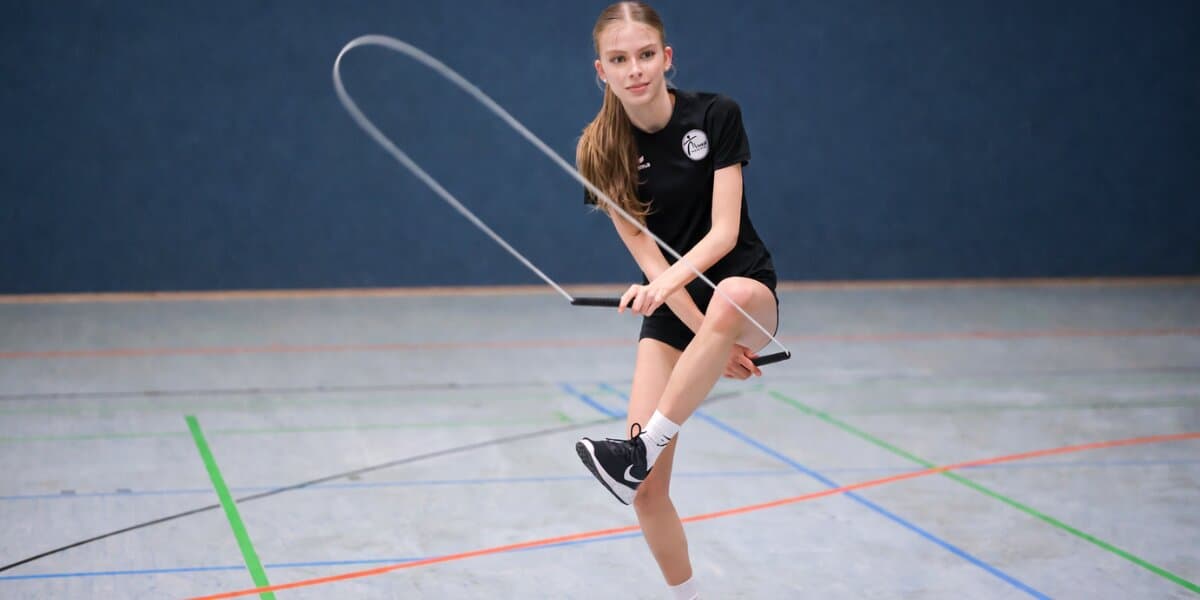
At fifteen, Germany’s federal rope-skipping champion knows what it costs to make 400 jumps look effortless.
Opitz recorded 400 counted jumps in a three-minute speed routine during her personal best performance. In competitive speed rope skipping, only one foot is counted per completed jump, meaning the result reflects 800 rope passes within the official time window. The discipline demands sustained rhythm, precise timing, and continuous coordination, as athletes are required to maintain speed and form without interruption for the entire duration of the routine.
Her performance secured top placement in her division and contributed to an overall championship result across categories. As a member of the Hessen State Squad since January 2025, Opitz trains within Germany’s structured youth athletics system, which supports regional development and national competition pathways for rope skipping athletes.
Competitive rope skipping occupies a niche but well-organized position within European youth athletics. While it receives limited mainstream media attention, the sport includes multiple standardized disciplines such as speed events, freestyle routines, and endurance formats. Athletes typically train through regional clubs, school-based programs, or shared sports facilities, with coaching focused on repetition, timing accuracy, and technical efficiency.
In speed-focused disciplines, training is typically built around high-repetition sessions designed to improve consistency under fatigue. Athletes may perform thousands of jumps per training cycle, emphasizing steady cadence, minimal error rates, and efficient energy use. Over time, this type of training develops lower-body endurance, coordination, and neuromuscular control, all of which are critical for maintaining performance in timed events.
Opitz’s athletic background includes early training in ballet, a discipline often associated with the development of posture, balance, and spatial awareness. She later participated in skiing and running, both of which contribute to aerobic conditioning, agility, and lower-body strength. These complementary athletic experiences are frequently referenced by coaches in rope skipping, particularly for athletes competing in speed categories where efficiency of movement and rhythm control are essential.
At the national level, rope skipping requires both physical conditioning and technical consistency across repeated performances. Because speed events are measured strictly by completed jumps within a fixed time period, even minor disruptions in rhythm or timing can significantly affect final results. For this reason, athletes often prioritize repetition-based training and stability over variation, with the goal of reducing performance variability under competitive pressure.
Germany’s youth development system for rope skipping integrates athletes into structured training environments that emphasize gradual progression and competition readiness. Athletes typically advance through regional competitions before qualifying for national championships, where performance standards become increasingly competitive. Within this framework, state squads such as Hessen’s provide additional training opportunities and access to higher-level coaching resources.
Beyond her athletic career, Opitz has also taken part in fashion and editorial work in Germany. Her appearances at Düsseldorf Fashion Days and participation in Silbernadel Couture 2025 reflect engagement in performance-based environments outside of sport. While distinct from athletics, these settings also require composure, timing, and awareness of movement under observation, skills that align with broader physical discipline and presentation training.
[IMAGE: https://bizweekly.com/wp-content/uploads/2026/04/download-1-39.jpg]
Balancing academic responsibilities with competitive training, Opitz continues to develop within Germany’s youth sports system. Like many athletes at her level, she manages school commitments alongside scheduled training sessions, particularly during preparation phases for regional and national events. This dual structure is common in youth athletics programs, where sporting development is integrated with education.
Her results at the federal championships position her among the more notable emerging athletes in Germany’s youth rope-skipping circuit, particularly in speed-based disciplines that prioritize repetition, precision, and sustained output over short durations. While rope skipping remains a relatively specialized sport compared to mainstream athletic categories, participation levels across Europe have remained stable, supported by school programs and regional sports organizations.
As the discipline continues to evolve, performances like Opitz’s highlight the structured training environments that underpin youth development in the sport. Her championship result reflects both individual consistency and the broader framework of organized athletic progression within Germany, where athletes advance through tiered competition systems designed to support long-term development in both technical and performance-based disciplines.
In addition to her public activities, Opitz maintains an online presence through social media platforms, including Instagram and TikTok, where she shares updates related to training and competitions:

Empire State Review Contributor
This article features branded content from a third party. Opinions in this article do not reflect the opinions and beliefs of Empire State Review.
You May Also Like

Animal Hospital Of Sullivan County Brings Compassion To Every Chapter Of A Pet’s Life
Animal Hospital Of Sullivan County Brings Compassion To Every Chapter Of A Pet’s Life

Carnegie Mellon Receives Historic $3 Billion Gift To Expand Research And Build Miami Campus
Carnegie Mellon Receives Historic $3 Billion Gift To Expand Research And Build Miami Campus

New York Scientific Data Summit Opens in Manhattan With Focus on AI’s Role in Science and Society
New York Scientific Data Summit Opens in Manhattan With Focus on AI’s Role in Science and Society

Hurricane Nolo Pounds Hawaii With Heavy Rain, Flooding, And Dangerous Surf
Hurricane Nolo Pounds Hawaii With Heavy Rain, Flooding, And Dangerous Surf

Akamai And Anthropic Sign $11.6 Billion Cloud Computing Deal As AI Infrastructure Demand Grows
Akamai And Anthropic Sign $11.6 Billion Cloud Computing Deal As AI Infrastructure Demand Grows